

Dry eye occurs when your eyes do not produce enough tears, or the right kind of tears. This can have a big impact on your productivity and overall quality of life and is one of the most common eye issues our patients are facing.
Common symptoms associated with dry eye are:
- Burning, stinging, or a scratchy sensation
- Eye redness
- Blurred vision and/or fluctuating vision throughout the day
- Light sensitivity
- Eye fatigue
- Feeling like there is something in your eyes
- Difficulty wearing contact lenses
- Watering eyes
There are 2 main types of dry eye disease:
- Evaporative dry eye, also known as Meibomian Gland Dysfunction (MGD) - happens when the tear film evaporates too quickly because the meibomian glands (oil glands) are not producing enough oil to coat the tear film. MGD is the leading cause of dry eye disease. The health of these glands can be assessed using meibography — an infrared imaging technique that shows the gland structure directly and can detect dropout or atrophy. See What is meibography? for more.
- Aqueous deficient dry eye — the lacrimal glands (water glands) that produce the tears are not functioning properly, so they cannot create the water layer of the tear film. Health issues such as autoimmune disorders or inflammatory conditions can both affect this layer.
Some patients may even experience a combination of both forms.
What causes dry eye disease?
To understand why your eyes are dry, it helps to know what a healthy tear film looks like. Your tear film has three main layers:
- Lipid layer — oil called meibum, pushed out from the meibomian glands in your eyelids. Its job is to stop your tears evaporating too quickly.
- Aqueous (water) layer — the salt water component forming the bulk of your tears. It carries elements that protect the eye while lubricating it.
- Mucous layer — mucin, which coats the cornea and helps spread the tear film evenly across your eye.
If your tear film composition is imbalanced, or you cannot produce enough good quality tears, this can leave you with dry eyes.
Finding the root cause for your dry eye can be difficult as there are many factors that can cause our eyes to not produce healthy tears. Here is a list of possibilities:
- Prolonged computer/screen use
- Lack of blinking during screen use
- Medications like antihistamines, mood stabilizers, birth control, hormone replacement, beta-blockers, pain relievers, gastrointestinal medications, retinoid, chemotherapy and more.
- Environmental factors - especially low indoor humidity during Canadian heating season, air quality, and HVAC systems
- Medical conditions like diabetes, Sjogren’s syndrome, rheumatoid arthritis, thyroid disorders, and lupus
- Natural aging process, menopause
- Allergies
- Smoking
- Wearing a face mask
Why drops often stop working
This is the part that confuses most people, and it follows directly from the two types above.
Artificial tears add moisture to the surface of the eye, so they help most when the problem is too little tear volume — aqueous deficiency. They can do very little when the problem is a blocked oil gland, because the tears you already have are evaporating too quickly. The symptoms of the two are nearly identical, so it is entirely reasonable to try drops first, find they stop helping, and conclude the drops do not work.
The drops were not wrong. They were treating the other mechanism. Working out which one you have is what changes the outcome.
What can I do?
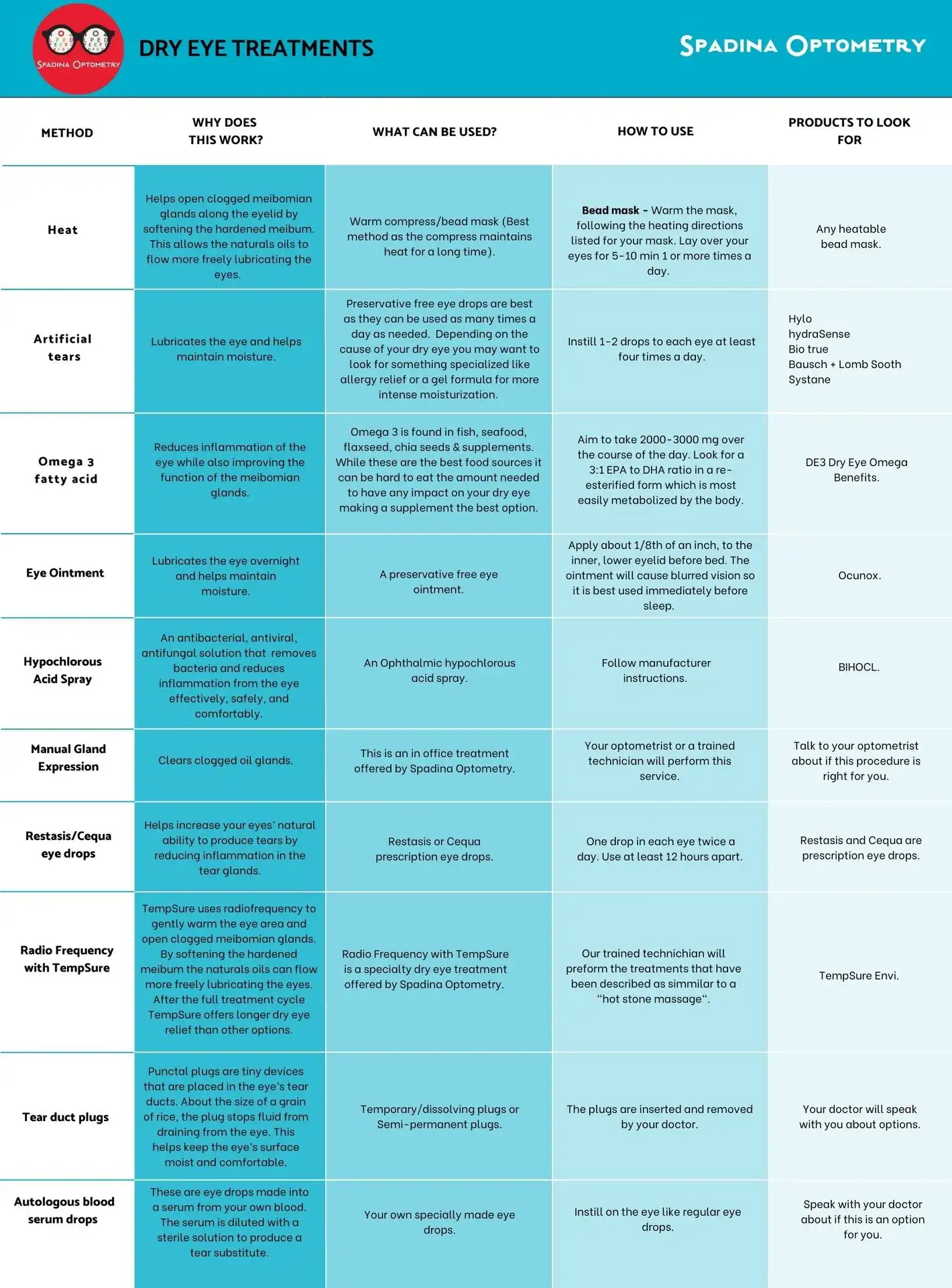
Treatments range from artificial tear drops and ointments to punctal plugs that keep your natural tears on the eye. Some patients benefit from oral supplements containing Omega-3 fatty acids. Others need a prescription eye drop that reduces inflammation or supports tear production. Where meibomian gland dysfunction is driving symptoms, treatment targets the glands themselves rather than topping up the tear film.
Which of these helps depends on which mechanism is causing your symptoms, which is what an assessment establishes. Tell your optometrist about any dry eye symptoms, including what you have already tried and whether it made any difference — that history is genuinely useful diagnostic information.
The chart at the foot of this page summarises the treatment options in more detail.
Dry eye diagnostics in Toronto
At Spadina Optometry in downtown Toronto, dry eye assessments can include meibography (infrared imaging of the meibomian glands), tear film evaluation, eyelid margin assessment, and clinical scoring. These diagnostics help us identify the root cause — whether it is gland dysfunction, aqueous deficiency, or a combination — and build a treatment plan that targets the actual problem.
We also offer TempSure Envi thermal radiofrequency treatment on-site for patients with Meibomian Gland Dysfunction, and can explain newer approaches such as light therapy for dry eye and blepharitis.
Who provides dry eye care at Spadina Optometry?
All of our optometrists provide dry eye care, working with each patient to build a plan matched to their symptoms and lifestyle.
Meet our doctors | Dry eye care at Spadina Optometry
Common questions
- Why are my eyes always dry?
- Chronic dry eyes are usually caused by one of two problems: your meibomian glands are not producing enough oil to prevent tears from evaporating too quickly (evaporative dry eye, the most common type), or your lacrimal glands are not producing enough of the watery component of your tears (aqueous-deficient dry eye). Common contributing factors include prolonged screen use, medications such as antihistamines or blood pressure drugs, autoimmune conditions, hormonal changes, low indoor humidity during heating season, and natural aging. At Spadina Optometry in downtown Toronto, we perform structured dry eye assessments to identify the root cause and build a targeted treatment plan.
- Why do my eyes water if they are dry?
- Watery eyes are one of the most common and counterintuitive symptoms of dry eye disease. When the tear film is unstable or evaporating too quickly, the eye’s surface becomes irritated and triggers a reflex flood of watery tears. These reflex tears are mostly water and lack the oil and mucin layers needed to stay on the eye, so they overflow without actually resolving the dryness. Treating the underlying cause — usually meibomian gland dysfunction — stops the cycle.
- Can dry eye disease be cured?
- Dry eye is typically a chronic condition that can be managed effectively but not permanently cured. The goal of treatment is to identify and address the root cause, restore tear film stability, relieve symptoms, and prevent progression — particularly meibomian gland loss, which is irreversible once it occurs. With the right combination of treatments, most patients achieve significant and lasting improvement in comfort. At Spadina Optometry, we use diagnostics including meibography to guide treatment and monitor progress over time.
- What are the types of dry eye disease?
- There are two main types. Evaporative dry eye, caused by meibomian gland dysfunction, is the most common — the oil glands in the eyelids are not producing enough lipid to prevent tear evaporation. Aqueous-deficient dry eye occurs when the lacrimal glands do not produce enough of the watery layer of the tear film, often associated with autoimmune conditions like Sjogren’s syndrome. Many patients have a combination of both types. A structured dry eye assessment can determine which type is driving your symptoms.
- Who provides dry eye care at Spadina Optometry?
- All of our optometrists provide dry eye care. They work with each patient to build a plan matched to their symptoms and lifestyle, and the clinic offers structured dry eye assessments including meibography and TempSure Envi thermal radiofrequency treatment for Meibomian Gland Dysfunction.
Drops not helping anymore?
If over-the-counter drops have stopped working, that is information, not failure. A structured dry eye assessment identifies which mechanism is driving your symptoms and what will actually treat it.
Prefer to talk first? Call or text us at 416-703-2797.
Spadina Optometry has cared for downtown Toronto patients since 2002 — an independent practice where the same team knows your eyes year after year.
Last reviewed: September 18, 2026